I love sleep. I really love a good long sleep and waking feeling well rested. It’s not the easiest thing to do though these days. Our lives are so busy, there are so many demands and temptations to stay up late and get up early. As the Bon Jovi song goes: “Until I’m six feet under / Baby I don’t need a bed / Gonna live while I’m alive / I’ll sleep when I’m dead…”
I love staying up late, and often find that I am very productive between midnight and 2.00am. However, since I almost inevitably wake up around 7.00am this limits my sleep to only five hours a night. Not enough for me. I really like seven to eight hours.
All in all it makes it difficult to get enough sleep and most importantly quality sleep. So when I recently saw this TED talk by Jessa Gamble about “biphasic sleep”, I was immediately captivated by the idea. Jessa’s research suggested that human beings evolved not to sleep the whole night through, but to sleep in two portions. One early in the night, the other a couple of hours later. The gap being filled by low level activity like talk, sex, reading etc.
You can read a longer article about Jessa’s work here:
http://magazine.utoronto.ca/feature/jessa-gamble-circadian-rhythm-chronobiology-seasonal-affective-disorder-polyphasic-sleep/
This style of sleep appeals to me strongly I am often tired in the early evening and ready for a sleep, but I force myself to stay up until later so that I will sleep right through and (hopefull
y) not wake up. But it’s a Catch22, since when I get to 11.00pm or midnight, I start to wake up again and feel active. That leads to me sometimes staying up too late researching an idea, or doing something else and then not getting enough sleep.
Biphasic sleep seems like the ideal answer – sleep for a while early in the evening when I am tired from a hard days work, wake up for a couple of hours and enjoy that uniquely quiet and peaceful time in the middle of the night, then drift off back to sleep again and sleep until dawn. It seems to suit my circadian rhythm really well.
So I decided to try it out. I have had two nights of early to bed with short periods of being awake in the middle of the night (which surprisingly) just happened naturally – I woke up around midnight without and prompts, and then drifted off to sleep again around 2.00am.
The only problem was that when I woke up, I had no idea what time it was and I found turning over and looking at the clock disturbing. I really didn’t want to do it. This lead me to thinking about a new project – something that I have dubbed The Midnight Clock.
The Midnight Clock would (as the name suggests) turn on around midnight. I would not however be harsh and bright, it would be a soft light that would gradually increase in brightness (to perhaps the intensity of a 10 watt incandescent globe) over the course of about 20 minutes, then hold that brightness until about an hour and ten minutes, at which point it would slowly fade away over the course of half an hour to nothing.
If I was very tired and just wanted to sleep, this “clock” would not wake me up, nor would it keep me awake. But it would be a direct indication of the time if I happened to wake up and wonder. If it’s fully dark, that’s ok, go back to sleep. If it’s getting lighter, then it’s ok to wake up more…
I am thinking that LEDs (warm white, or RGB which I could tune to an orange/red part of the spectrum) would be ideal, driven by an Arduino board to handle the light level and timing. The Adruino would be capable of driving the LEDS without needing a separate power supply and pulse width modulation (PWM) hat or add on, so the system would be simple and compact.
I am going to put this project on my list for the near future. It’s a good little one day Quick Project and would be a nice addition to my on going science experiment with sleep.
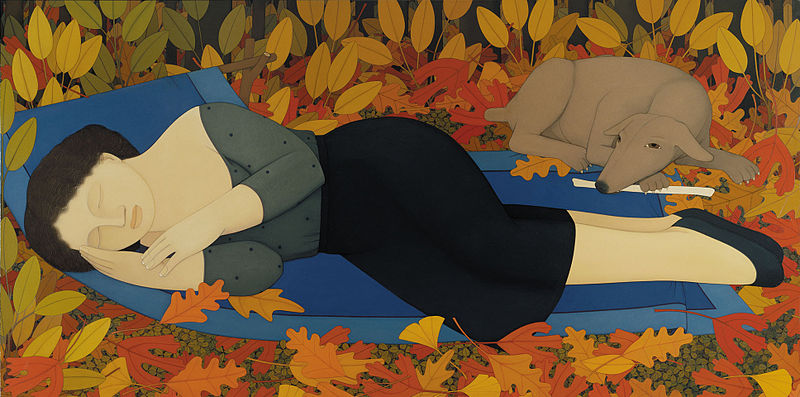
The image attached to this post is an oil painting by Andrew Stevovich, Woman with Autumn Leaves, 1994, 36″ x 72″, Private Collection
from: https://commons.wikimedia.org/wiki/File:Andrew_Stevovich_oil_painting,_Woman_with_Autumn_Leaves,_1994,_36%22_x_72%22.jpg